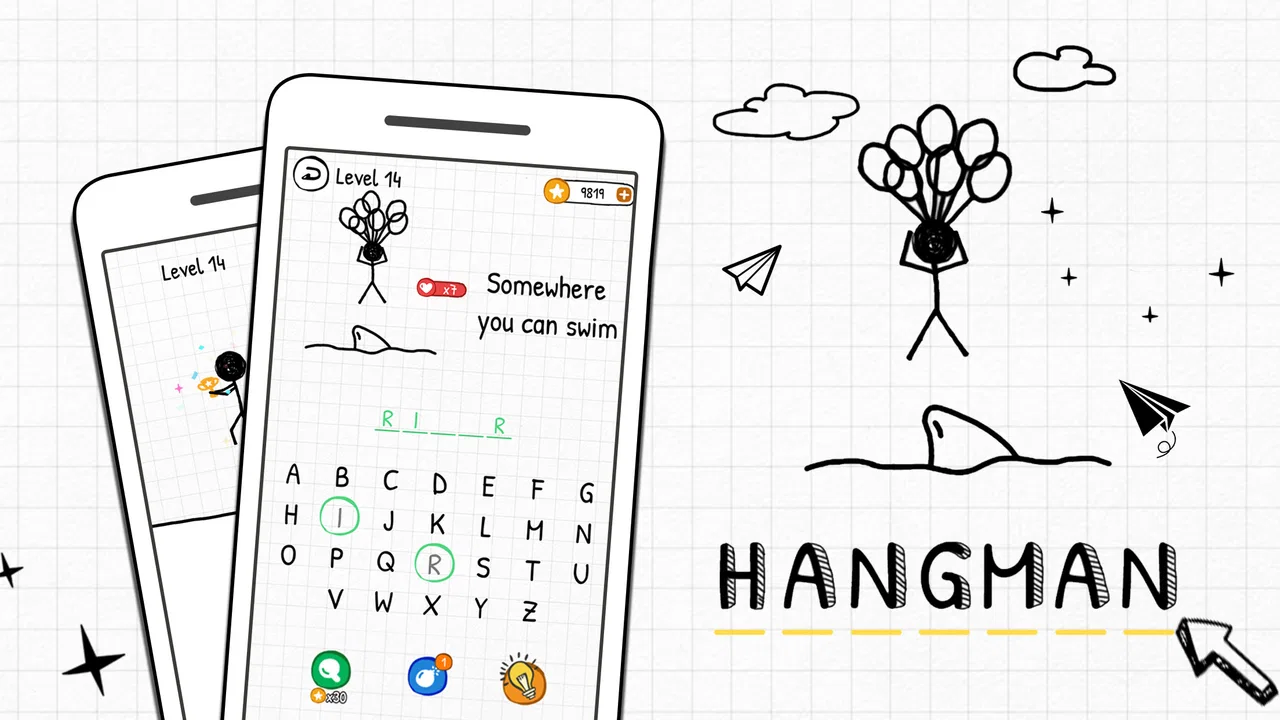
Hangman Words:Two Player Games
- 4.8
- Rating
- 10.00M
- Installs
- Free
- Price

 Analysis by App-foxy
Hangman Words:Two Player Games is the kind of word game I can understand within a minute and still enjoy after the first few rounds. It takes the familiar hangman idea and puts the emphasis on two-player play, making it a natural choice for a quick match with a friend, a child, a sibling, or someone sitting beside you. I found the appeal less about discovering a complicated system and more about how quickly it turns an idle moment into a small contest of vocabulary and deduction.
What makes it worth considering is its focused design. This is not a broad collection of unrelated puzzles competing for your attention. It is a free word game built around hangman-style guessing, developed by Kerun Games, with a simple premise that is easy to explain to someone who has never opened it. The store short description is “Hangman Words,” while the longer summary points directly to its two-player identity and the familiar goal of saving the hangman.
I would not describe it as a game that replaces a deep strategy title or a full solo word-learning course. Its value comes from convenience, shared play, and the fact that a round can begin without much preparation. If you want a lightweight game for repeated short sessions, it has a clear reason to exist. If you need a large campaign, extensive progression, or a constantly changing challenge, its narrow focus may become noticeable fairly quickly.
You May Also Like

 Blood Strike: 2.5 Anniversary
Blood Strike’s Loadouts Turn Every Drop Into a Tactical Gamble
A close look at Blood Strike’s custom loadouts: how fast access to signature weapons reshapes its battle royale rhythm, rewards preparation, and narrows the gap between fights.

 Pandora - Music & Podcasts
Pandora’s Music Is Easy to Start, but Harder to Recover
Pandora’s strength is its low-effort path from a seed to a station. Its weak spot is how much confidence it asks you to place in connection, setup, and quiet recovery.

 8 Ball Pool
 Is Built on Rivalries, Rematches, and Routine
A close look at the rivalries, rematches, shared routines, and unanswered safety questions that turn a quick pool match into a persistent mobile community.

 Samsung Music
’s Quiet Strength Is Playing What You Already Own
Its reach comes less from spectacle than from dependable access to a personal library. That simplicity is both the app’s strongest retention engine and its ceiling.

 AccuWeather: Weather Radar
AccuWeather Review: A Quick, Clear Forecast for Everyday Decisions
For everyday plans, the best forecast is the one you can understand quickly. AccuWeather makes rain timing, radar, and local conditions easy to act on, with a few trade-offs.

 Hill Climb Racing
Why Hill Climb Racing Still Turns Crashes Into One More Run
A tiny car, a bumpy hill and one more upgrade: Hill Climb Racing keeps resurfacing because its simple chaos makes every near-miss feel personal.
More From Our News Desk
View All News


How the first week feels in actual use
During the first few sessions, the strongest quality is accessibility. Hangman is already familiar to many people, so the basic objective does not need a tutorial-heavy explanation. One player thinks about or selects a word, and the other works through letters while trying to avoid too many mistakes. That simplicity makes the game especially suitable for casual social use: you can hand the phone to another person and start playing rather than spending several minutes explaining controls, menus, or special rules.
I found the two-player format more important than it may sound. A standard solo word puzzle can be relaxing, but it can also feel routine because the game controls the challenge. Here, another person becomes part of the difficulty. A friend may choose an unexpectedly obscure word, while a younger player may prefer familiar vocabulary. That human element gives each round a small amount of personality that a fixed daily puzzle or automated word list cannot always provide.
A realistic use case is a short wait before an appointment or a few minutes at home when two people want something to do without committing to a long game. It also works well as a simple family activity because the rules are easy to follow and the age rating is Everyone. I would still adjust word choices to the people playing; a child and an adult may have very different ideas about what counts as a fair challenge. The game can support that kind of informal adjustment because the social interaction is central to the experience.
The early novelty comes from testing one another rather than from unlocking a large amount of content. That distinction matters. I enjoyed the first week most when I treated each match as a conversation starter: choosing a word connected to a recent event, challenging someone with a word from a shared hobby, or deliberately selecting something approachable for a younger player. Used this way, the game becomes a small tool for interaction rather than merely another application to scroll through.
Why the two-player focus matters
Many word games are designed around solo repetition. They ask you to solve a puzzle, beat a timer, or maintain a personal streak. Hangman Words:Two Player Games offers a different rhythm because the opponent is physically or socially present. That makes it a better fit for people who enjoy playful disagreement and quick back-and-forth decisions than for someone who prefers quiet individual practice.
The format also creates a useful trade-off. A human opponent can make the game feel less predictable, but the quality of the match depends on both players. If one person chooses words that are far too difficult, refuses to offer fair challenges, or simply loses interest, the application cannot create the same momentum on its own. In a solo alternative, the game can usually guarantee a steady flow of puzzles. Here, the social partner is both the main strength and a possible limitation.
For that reason, I would introduce it as a shared activity rather than install it expecting a large amount of independent content. The first-week question is not only “Do I like hangman?” It is also “Do I regularly have someone who wants to play it with me?” If the answer is yes, the simple design feels purposeful. If the answer is no, the attraction may fade sooner than it would with a solo word app.
Small habits that make early sessions better
One practical habit is to agree on the type of words before starting. A round based on everyday objects feels very different from one based on names, places, school vocabulary, or specialist interests. Setting that expectation reduces arguments about whether a word is reasonable and gives each match a clearer identity. It is a small change, but it makes the game feel less random and more like a deliberately chosen challenge.
I also recommend alternating difficulty instead of trying to win every round through the most obscure word possible. A fair match usually lasts longer and gives both players a reason to continue. If you are playing with a child, begin with familiar words and use the opportunity to discuss spelling rather than turning every mistake into a penalty. With adults, increasing difficulty gradually is more enjoyable than opening with an impossible answer.
Another useful approach is to treat a session as a set of short rounds rather than one serious competition. That keeps a lucky guess or an early mistake from deciding the entire experience. It also suits the app’s casual nature: the game is at its best when it fills a small amount of time without demanding that players reorganize their day around it.
What remains after the novelty wears off
The long-term value depends on whether you enjoy the social ritual of playing, not on a large progression system. After the first week, the basic hangman structure becomes familiar. That is not automatically a weakness; familiar rules are exactly why the game is easy to return to. But familiarity also means the application needs a reason to be opened again. In my experience, that reason comes from the person you play with, the words you choose, and the situations in which you use it.
Month to month, it can work as a dependable fallback for short shared sessions. You do not need to remember a complex control scheme, and you can create a different feel simply by changing the vocabulary or opponent. It is particularly useful for families who want a low-pressure word activity, friends who enjoy light competition, or anyone looking for a quick alternative to endlessly watching short videos together.
Its recurring value is weaker for players who expect the application itself to supply a deep stream of fresh content. A daily puzzle service, a crossword platform, or a larger word-game collection may offer more variety without requiring another person to provide the energy. Those alternatives are better when you want structured solo practice, a persistent challenge, or a stronger sense of progression. Hangman Words:Two Player Games earns its place through immediacy and shared play rather than breadth.
The high public response gives some indication that the straightforward concept connects with a large audience: the game has a 4.9 average from around 240 thousand ratings and has passed 10 million installs. I see those figures as evidence of broad appeal, not proof that every player will find lasting depth. A simple game can be widely liked and still be the wrong match for someone who wants more advanced word mechanics.
Who is most likely to keep using it
I think it has the best chance of becoming a regular part of your phone when you already have a clear use for two-player word play. Parents can use it for a quick spelling-oriented activity, couples can use it for a low-stakes contest, and friends can keep it ready for moments when a conversation needs a playful break. Because it is free to install, the barrier to trying it is low, although optional in-app purchases range from $0.99 to $4.99 per item.
It is also a sensible choice for people who dislike complicated mobile games. The category is easy to understand, the central activity is familiar, and the Everyone content rating makes it broadly approachable. Someone who has avoided word games because they seem intimidating may find this format more welcoming than a crossword with a large grid or a vocabulary game filled with advanced terminology.
On the other hand, I would point a dedicated word enthusiast toward a richer alternative if their main goal is learning new vocabulary or improving spelling through structured feedback. Hangman can encourage thinking about letters and word patterns, but it is not the same as a guided language course. Likewise, a player who usually plays alone should consider whether the two-player focus matches their routine before expecting it to become a daily habit.
Maintenance, friction, and reasons to stop opening it
The maintenance burden is low in one sense: the game does not ask you to manage a complicated build, memorize a large ruleset, or maintain a long-term strategy. You can return after a break and understand what to do immediately. That makes it more resilient than games whose appeal depends on keeping up with events or remembering a detailed progression path.
There is still a different kind of maintenance: keeping the social habit alive. You need a willing opponent, a suitable moment, and enough agreement about word difficulty for the rounds to feel fair. If you are the only person interested, the application’s central design becomes a constraint. This is the most important practical question to answer before installing it, and it is more significant than the low download price.
The other likely source of fatigue is repetition. Hangman has a limited core loop, and the first few sessions expose most of its basic appeal. If every match uses the same style of words and the same competitive pattern, the experience can start to feel like a familiar pastime rather than a fresh game. The solution is not to force longer sessions. Shorter play, rotating themes, and different opponents preserve the format better than trying to extract an hour from it.
There is also a social fatigue that is easy to overlook. A game based on guessing can become frustrating when one player dominates or when the chosen words feel deliberately unfair. I would avoid using it as a serious test of intelligence. It works better when both players agree that the objective is entertainment, with the occasional chance to learn a word or notice a spelling pattern along the way.
The current version is 1.5108, and it supports devices running Android 6.0 or later. Those details make it accessible to people using older compatible Android hardware, but they do not change the central judgment: technical availability is not the same as long-term suitability. The deciding factor remains whether the two-player structure fits your real routine.
How it compares with familiar alternatives
Compared with a solo crossword, this game is faster to explain and more conversational, but it offers less depth and less independent challenge. Compared with a daily word puzzle, it is more flexible because the players can shape the words and difficulty, yet it may lack the reliable routine that makes daily games easy to revisit. Compared with a large board-game app, it is more focused and less demanding, but it also provides fewer different ways to play.
That makes the choice fairly clear. Pick this one when you want a quick, recognizable word contest with another person. Choose a solo word-learning tool when personal improvement is the priority. Choose a broader game collection when you want variety in the same application. The fact that Hangman Words:Two Player Games is free makes it easy to test this distinction without treating the installation as a major commitment.
I would also keep expectations realistic around purchases. Since individual in-app items are available within the stated price range, anyone who wants to keep spending at zero should pay attention to what is optional before buying. The free entry point is attractive, but “free” does not mean every possible addition is included without cost. For a casual player, that is usually manageable as long as the purchase decision is deliberate rather than made during a moment of competition.
My long-term verdict
After the initial novelty fades, Hangman Words:Two Player Games remains useful when it is treated as a compact social activity rather than a content-heavy word platform. I like that it gets to the point, welcomes players who may not enjoy complicated games, and gives two people a reason to interact without requiring a long session. Its strongest feature is not a complex mechanic; it is the way a familiar format becomes more engaging when another person is making the choices.
I would recommend it to families, friends, and couples who want a simple game ready for spare moments. I would be more cautious recommending it to someone who mainly plays alone, wants a deep vocabulary curriculum, or becomes bored quickly with repeated mechanics. For those users, a richer solo word game or a broader puzzle collection will probably earn more lasting attention.
Kerun Games has kept the concept focused, and that focus is both the reason to install it and the reason some players will eventually move on. If you build a small habit around fair word choices, rotating themes, and short matches, it can stay enjoyable well beyond the first few days. Its lasting value comes from the people and situations around the game, not from pretending that a simple hangman loop is something larger than it is.
My final view is positive but specific: this is a good free choice for two-player word entertainment, especially when you want something immediate and easy to share. It does not need to become a daily obsession to justify its space on a phone. If it reliably helps fill a wait, start a family game, or give two friends a few minutes of friendly competition, it has already found the role it was designed to play.
FAQs for Hangman Words:Two Player Games
01What is Hangman Words: Two Player Games?
Hangman Words: Two Player Games is a mobile app that brings the classic word-guessing game to your smartphone. The app allows you to challenge friends or play against the AI, offering a fun and educational experience for users of all ages. It features various difficulty levels and categories to keep the gameplay exciting.
02Is Hangman Words: Two Player Games free to download and play?
Yes, Hangman Words: Two Player Games is free to download and play. However, it may offer in-app purchases, such as hints or additional word categories, to enhance the gaming experience. These purchases are optional, and users can enjoy the core game without spending any money.
03Can I play Hangman Words offline?
Hangman Words: Two Player Games can be played offline, making it convenient for users who want to enjoy the game without an internet connection. However, some features, like leaderboards or multiplayer with friends, may require an internet connection to function properly.
04What age group is Hangman Words suitable for?
Hangman Words: Two Player Games is suitable for a wide range of ages, from children to adults. The app offers different difficulty levels and educational word categories, making it an excellent tool for learning and fun. Parents can use it as a way to enhance their children's vocabulary in an engaging manner.
05How do I play with a friend on Hangman Words?
To play with a friend on Hangman Words: Two Player Games, you can invite them via the app's multiplayer option. You can either play on the same device by taking turns or connect online to challenge each other remotely. This flexibility makes it perfect for social gaming, whether you're together or apart.
Pros
- Engaging multiplayer mode enhances fun.
- Simple interface makes navigation easy.
- Variety of word categories available.
- Quick game setup; start playing instantly.
- Minimal ads; non-intrusive experience.
Cons
- Limited single-player options available.
- Repetitive music can become annoying.
- Occasional lag in multiplayer mode.
- No offline mode for solo play.
- In-app purchases can be expensive.

Hangman Words:Two Player Games
Gallery